
Quantum computing is evolving at an incredible pace, but one of its biggest challenges is dealing with errors that occur during quantum calculations. Among the emerging solutions, s-nisq quantum error correction is gaining attention as a practical method for improving the reliability of quantum computers during the current technological stage known as the NISQ era.
In this article, we will explore everything about s-nisq quantum error correction, including its concept, history, development journey, applications, impact on quantum computing, and even a simplified “technology profile” including bio, career progress, and estimated market value growth.
What is S-NISQ Quantum Error Correction?
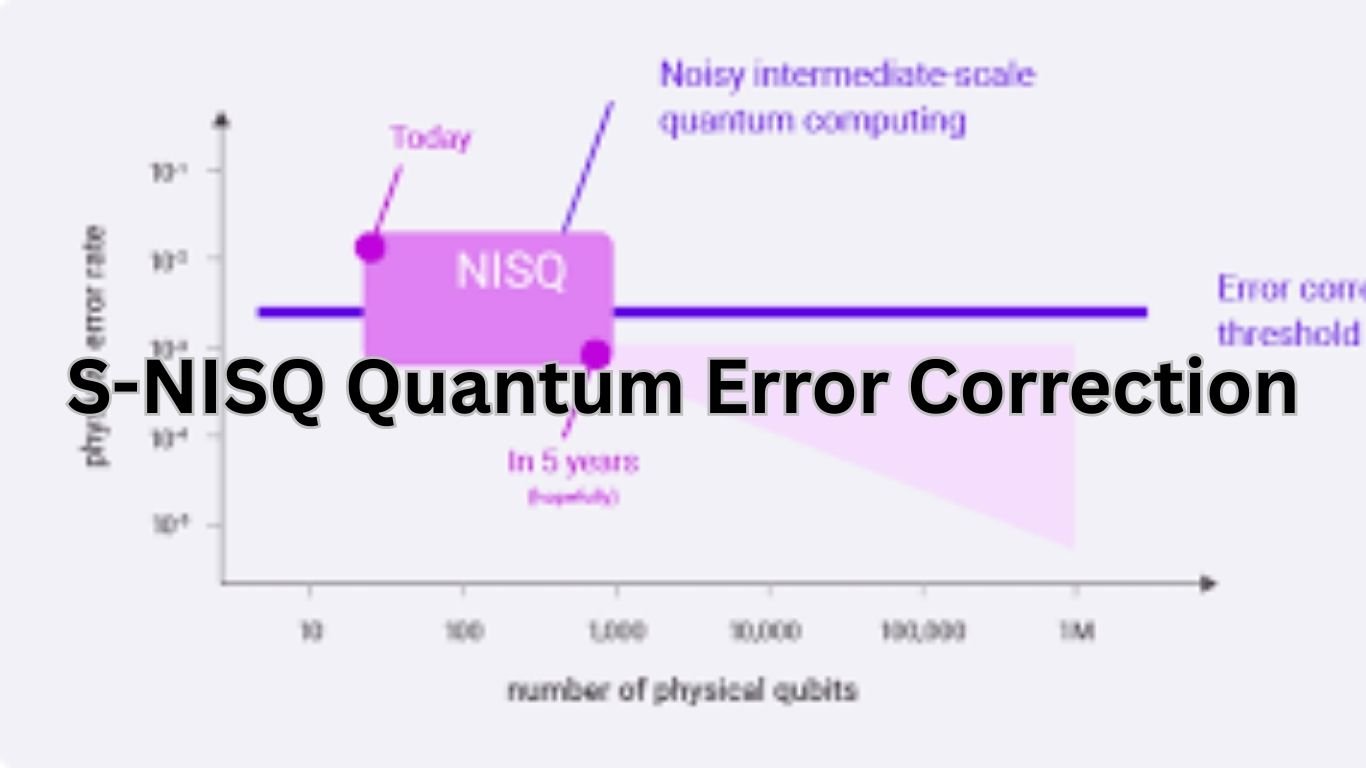
S-NISQ quantum error correction refers to a selective or structured approach to correcting errors in NISQ (Noisy Intermediate-Scale Quantum) systems. The NISQ era describes the current generation of quantum computers that contain tens to hundreds of qubits but still suffer from high levels of noise and instability.
Traditional quantum error correction requires thousands of qubits to protect a single logical qubit, making it impractical for today’s hardware. Instead, s-nisq quantum error correction focuses on applying targeted error correction methods only where they are most needed.
This strategy allows quantum systems to become more stable and useful without requiring massive hardware resources.
In simple terms:
- Classical computers correct errors using redundancy.
- Quantum computers use complex encoding methods.
- S-NISQ uses selective correction to improve efficiency in current hardware.
Quick Bio: S-NISQ Quantum Error Correction
| Attribute | Details |
|---|---|
| Name | S-NISQ Quantum Error Correction |
| Field | Quantum Computing |
| Concept Type | Error Correction Method |
| Origin | Developed during the NISQ era of quantum computing |
| Purpose | Reduce errors in noisy quantum devices |
| Key Advantage | Targeted error correction with lower hardware requirements |
| Main Applications | Quantum algorithms, cryptography, material science research |
| Future Potential | Bridge to fault-tolerant quantum computing |
This “bio” summarizes the identity of the concept within the world of advanced computing research.
The Career Journey of S-NISQ Quantum Error Correction
Just like a professional career, technological ideas also evolve through stages. The development of s-nisq quantum error correction can be viewed in several phases.
Early Stage: The NISQ Era Begins
The term NISQ was introduced to describe current quantum computers that are powerful but still noisy and prone to errors. These systems can perform complex calculations but lack full fault-tolerant error correction.
During this period, researchers realized that full quantum error correction would require thousands of additional qubits per logical qubit.
That made it impractical for near-term hardware.
Mid Stage: Development of Practical Error Mitigation
To solve this issue, scientists began developing error mitigation techniques, which reduce errors without requiring full correction.
Examples include:
- Zero-noise extrapolation
- Measurement calibration
- Probabilistic error cancellation
These methods helped improve results but still lacked real-time correction capabilities.
Modern Stage: Emergence of S-NISQ Quantum Error Correction
S-NISQ methods introduced a new strategy:
Instead of correcting every qubit equally, focus on the parts of the system where errors occur most frequently.
This selective strategy provides several advantages:
- Lower qubit overhead
- Faster computations
- More efficient use of hardware
Because of this, many researchers consider s-nisq quantum error correction a bridge between today’s quantum computers and future fault-tolerant machines.
Understanding Quantum Errors
Quantum systems are extremely sensitive.
Errors can occur due to:
1. Decoherence
Quantum states lose information because of environmental interaction.
2. Gate Errors
Quantum operations may not execute perfectly.
3. Measurement Errors
Reading qubit states can introduce inaccuracies.
Quantum error correction works by:
- Detecting errors
- Identifying the faulty qubit
- Restoring the correct quantum state
These steps help maintain reliable computations.
Family of S-NISQ Techniques
Just like technologies often belong to a family of related methods, s-nisq quantum error correction works alongside several other approaches.
Error Mitigation
Reduces noise after computation.
Quantum Error Correction Codes
Protect qubits using encoded logical states.
Surface Codes
Advanced codes used in experimental quantum processors.
Together, these techniques create a layered defense against errors in quantum systems.
Applications of S-NISQ Quantum Error Correction
S-NISQ technology is extremely important for real-world quantum applications.
Drug Discovery
Quantum simulations can model molecules with high precision, accelerating pharmaceutical development.
Material Science
Scientists use quantum computing to design new materials with advanced properties.
Cryptography
Quantum algorithms can potentially break classical encryption, making error correction essential for secure calculations.
Optimization Problems
Industries such as logistics, finance, and energy can benefit from improved quantum algorithms.
Net Worth of S-NISQ Quantum Error Correction (Technology Market Value)
Although s-nisq quantum error correction is a research concept rather than a person, we can estimate its economic impact through the quantum computing industry.
Below is a simplified technology “net worth” growth chart representing the value of quantum error correction research and related markets.
| Year | Estimated Technology Market Value |
|---|---|
| 2023 | $1.2 Billion |
| 2024 | $1.8 Billion |
| 2025 | $2.6 Billion |
| 2026 | $3.9 Billion |
The increasing investment reflects how critical error correction technologies are for the future of quantum computing.
Major companies investing in these technologies include:
- IBM
- Microsoft
- Rigetti
- IonQ
As quantum computing matures, the value of error correction technologies like s-nisq will continue to grow significantly.
Why S-NISQ Quantum Error Correction Matters
The biggest challenge in quantum computing today is noise.
Without reliable error correction:
- Results become unreliable
- Large computations become impossible
- Quantum advantage cannot be achieved
S-NISQ helps solve this by providing practical, near-term solutions that work with existing hardware.
It acts as a bridge between:
Current Quantum Devices → Fully Fault-Tolerant Quantum Computers.
Future of S-NISQ Quantum Error Correction
The future of quantum computing depends heavily on error correction breakthroughs.
Possible future developments include:
Hybrid Error Correction Systems
Combining classical computing with quantum correction algorithms.
Hardware-Level Error Protection
New qubit designs that naturally resist errors.
AI-Based Noise Detection
Machine learning models that predict and correct quantum errors automatically.
If these innovations succeed, the dream of large-scale quantum computing could become reality within the next two decades.
Pros and Cons of S-NISQ Quantum Error Correction
Advantages
- Lower qubit requirements
- Compatible with current hardware
- Improves reliability of NISQ devices
- Accelerates quantum algorithm development
Limitations
- Not fully fault-tolerant
- Limited scalability
- Still under active research
Despite these challenges, the technology is one of the most promising solutions for near-term quantum computing.
Frequently Asked Questions (FAQs)
1. What does S-NISQ stand for?
S-NISQ typically refers to Selective or Structured Noisy Intermediate-Scale Quantum error correction, which applies targeted correction strategies to quantum systems.
2. Why is quantum error correction necessary?
Quantum systems are extremely fragile. Even small environmental interactions can introduce errors that disrupt calculations.
3. Is S-NISQ better than traditional quantum error correction?
Not necessarily better, but more practical for current hardware because it requires fewer qubits.
4. Will S-NISQ replace full quantum error correction?
No. It is considered a temporary bridge technology until large-scale fault-tolerant quantum computers become available.
5. What industries benefit from S-NISQ quantum error correction?
Industries such as pharmaceuticals, finance, logistics, cybersecurity, and material science can benefit from improved quantum reliability.
Conclusion
S-NISQ quantum error correction represents one of the most promising solutions for improving quantum computing reliability in the near term. By applying targeted error correction techniques, researchers can make today’s noisy quantum computers more practical and capable.
While it may not completely solve the challenges of quantum errors, it provides an essential stepping stone toward the future of fault-tolerant quantum computing.
As research continues and investments grow, the importance of s-nisq quantum error correction will only increase—potentially transforming industries and pushing the boundaries of what computers can achieve.
