

The American college experience is increasingly a balancing act. According to the National Center for Education Statistics (NCES), approximately 40% of full-time undergraduate students and 74% of part-time students are employed while specialized in their degree programs. As the semester reaches its crescendo in the United States, the pressure of maintaining a high GPA while fulfilling shifts at work can lead to burnout.
However, academic success and professional responsibility do not have to be mutually exclusive. By leveraging data-driven time management strategies and knowing when to utilize external resources, students can navigate the “Finals Week” gauntlet without sacrificing their mental health or their paycheck.
The Cost of the “Hustle”: Understanding the Stakes
For many students in cities like New York, Los Angeles, or Chicago, part-time work isn’t just for extra spending money; it’s a necessity for rising tuition and housing costs. Yet, research from the Georgetown University Center on Education and the Workforce suggests that students working more than 20 hours a week are less likely to attain high grades compared to those who work fewer hours. The challenge lies in the “cognitive load”—the mental energy required to switch from a professional mindset back to an academic one.
When the workload becomes unsustainable, many students look for ways to delegate their tasks effectively. During peak exam seasons, it is not uncommon for high-achievers to seek a professional to do my assignment for me to ensure their technical papers meet rigorous university standards. This strategic move allows students to focus on high-stakes exams that require physical presence, while ensuring their written coursework remains top-tier.
Strategic Planning: The 168-Hour Rule
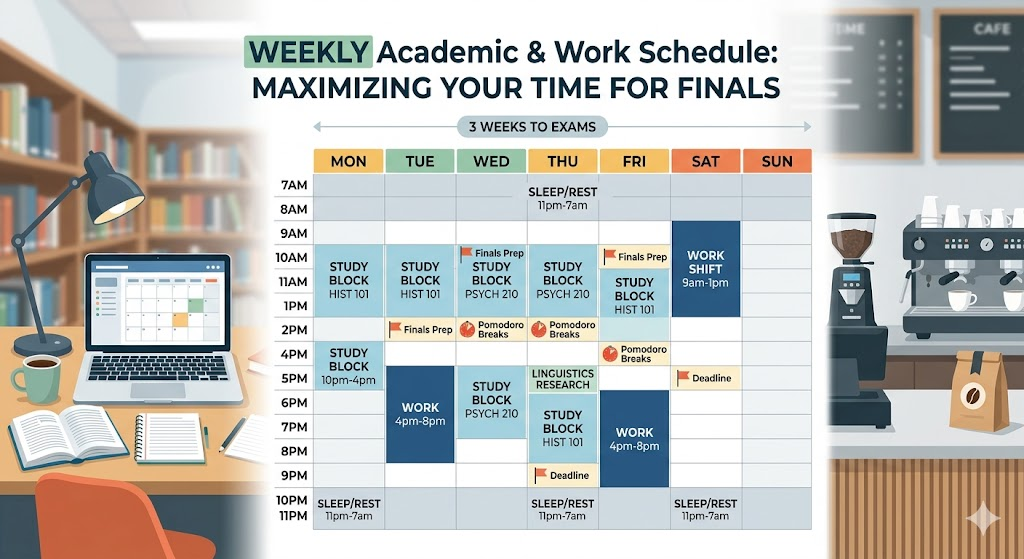
Every student has 168 hours in a week. Successful balancing acts aren’t about working harder; they are about granular scheduling.
- The Syllabi Audit: Two weeks before finals, map out every deadline. US universities often stagger finals, but term papers usually cluster in the same 48-hour window.
- The “Work-Block” Method: Instead of “studying all day,” assign specific hours to specific tasks. For example, if you are a social science major, you might dedicate Tuesday night specifically to brainstorming linguistics research topics if you are enrolled in a morphology or syntax course. Having a pre-vetted list of topics prevents the “blank page syndrome” that wastes precious hours.
- The Employer Conversation: Most US employers, especially in campus towns, understand the academic cycle. Requesting a “shift reduction” or “shift swap” at least three weeks in advance is a standard professional courtesy.
Data-Driven Productivity Hacks for Finals Week
- The Pomodoro Technique (Modified): Studies suggest that the brain’s focus wanes after 50 minutes. Work for 50, break for 10. During the 10-minute break, physically move away from your desk.
- Active Recall vs. Passive Reading: A study published in Psychological Science in the Public Interest found that highlighting and re-reading are the least effective study methods. Instead, use flashcards or “blurting” to trigger active memory retrieval.
- The Sleep Dividend: The American Academy of Sleep Medicine warns that “all-nighters” impair cognitive function. For those struggling with time-intensive papers, seeking academic assistance can provide the breathing room needed for a full night’s rest.
Navigating Complex Research Projects
Large-scale research projects often act as the “anchor” for your final grade. In the US, the transition to Next-Gen academic standards means professors are looking for deeper critical analysis.
If you are struggling to narrow down a thesis—particularly in complex fields like the humanities—utilizing professional writing support can provide the necessary spark. For instance, exploring modern sociolinguistic trends through a curated list of research themes can shave hours off your preliminary research phase.
Key Takeaways
- Start Early: The “Finishing Line” begins three weeks before the actual exams.
- Communicate: Inform your manager about your exam schedule early to secure time off.
- Leverage Resources: Don’t hesitate to use specialized guides for heavy documentation or editing tasks.
- Quality over Quantity: Focus on active recall study sessions rather than long, distracted hours at the library.
Frequently Asked Questions (FAQs)
1. How many hours should a full-time student work per week?
Most academic advisors in the USA recommend a maximum of 10–15 hours per week to maintain a balance between work and physical health.
2. What is the most effective way to study for finals while working?
“Time-blocking” is the most effective method. Assign specific subjects to specific days and treat your study time as an unmissable “shift” similar to your job.
3. Is it ethical to use assignment help services?
Using services for tutoring, proofreading, or as a structural guide is a common practice to enhance learning and understand professional formatting standards.
4. How do I choose a research topic quickly?
Use academic resource blogs that offer pre-categorized lists. For example, looking up specialized fields like linguistics can help you bypass the initial struggle of topic selection.
Author Bio
Jane Sullivan is a Senior Academic Consultant at MyAssignmentHelp. With over a decade of experience in the US higher education sector, Jane specializes in helping students optimize their learning workflows and overcome academic burnout. She holds an M.Ed. from the University of Massachusetts and is a frequent contributor to discussions on student productivity and digital learning tools.
References & Data Sources
- National Center for Education Statistics (NCES) – “College Student Employment” Report (2024-2025).
- Georgetown University Center on Education and the Workforce – “Learning While Earning” Study.
- American Academy of Sleep Medicine – “Impact of Sleep Deprivation on Academic Performance.”
- Dunlosky, J. et al. (2013). “Improving Students’ Learning With Effective Learning Techniques,” Psychological Science in the Public Interest.