
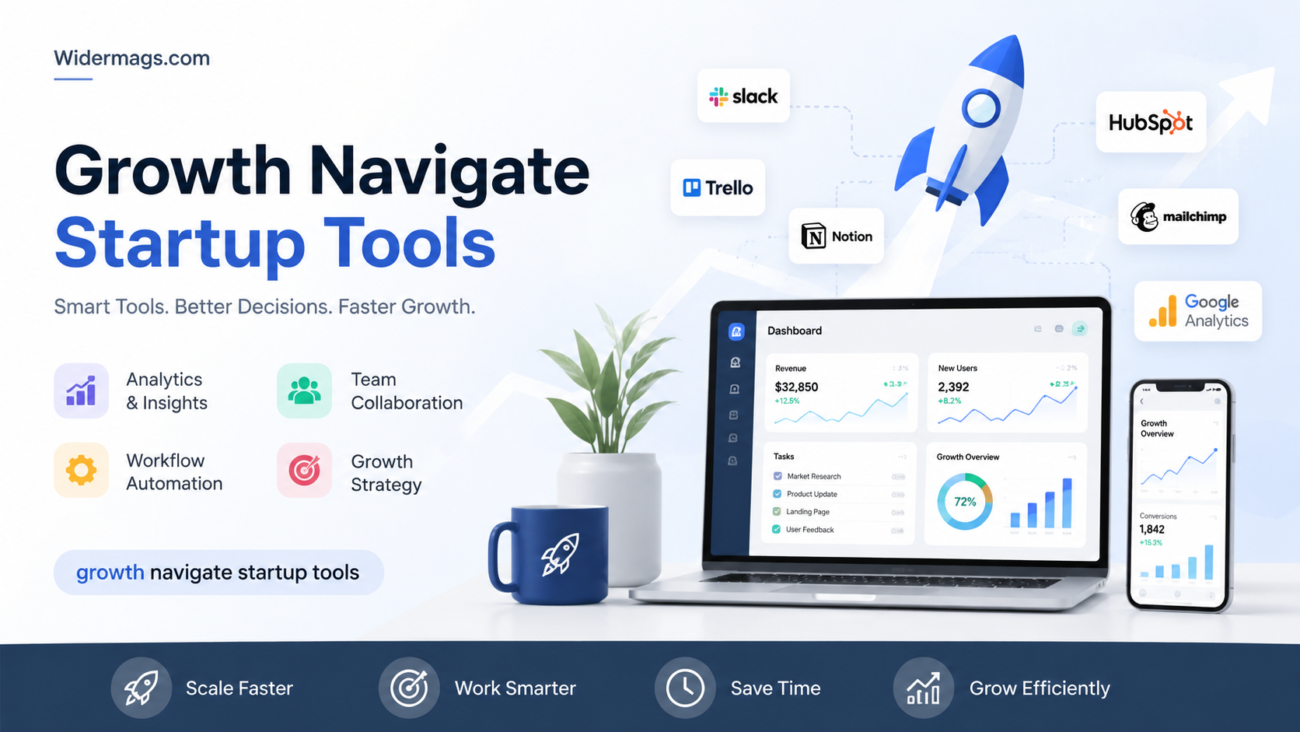
In today’s competitive business environment, startups face immense pressure to grow quickly while maintaining efficiency and controlling costs. Founders often struggle with limited resources, small teams, and rapidly changing market demands. This is where growth navigate startup tools become essential. These tools help entrepreneurs streamline operations, improve decision-making, automate repetitive tasks, and create scalable systems that support sustainable business growth.
Whether you are launching a new venture, managing a growing SaaS company, or building an eCommerce brand, the right startup tools can significantly improve productivity and accelerate expansion. Modern startups rely on a wide range of solutions for project management, customer relationship management, marketing automation, analytics, communication, and financial management.
This comprehensive guide explores the importance of growth navigate startup tools, the categories that matter most, and how founders can choose and implement the best solutions for long-term success.
What Are Growth Navigate Startup Tools?
Growth navigate startup tools refer to software solutions, platforms, and digital systems designed to help startups manage growth effectively. These tools simplify complex business processes and allow founders to focus on strategy, innovation, and customer acquisition instead of administrative tasks.
As startups expand, manual processes become increasingly inefficient. Teams need better collaboration, automated workflows, accurate data insights, and scalable infrastructure. Growth-oriented tools provide these capabilities while reducing operational friction.
The modern startup ecosystem offers thousands of software options covering every business function imaginable. From marketing automation and sales tracking to financial forecasting and team collaboration, these tools help organizations navigate growth challenges with confidence.
The primary objective of growth navigate startup tools is not simply automation. Their real value lies in enabling startups to make smarter decisions, increase efficiency, and maintain sustainable growth trajectories.
Why Startups Need Growth-Focused Tools
Many startups fail not because their products are poor but because their operations cannot keep pace with growth. Scaling introduces new challenges such as customer management, team coordination, resource allocation, and financial oversight.
Growth-focused tools help startups overcome these obstacles by creating structure and visibility. They centralize information, automate repetitive tasks, and provide actionable insights through data analytics.
When businesses rely on spreadsheets and manual processes, mistakes become more frequent as operations expand. Important customer information gets lost, deadlines are missed, and reporting becomes unreliable. Dedicated startup tools eliminate many of these risks.
Additionally, startups often operate with lean teams. Employees wear multiple hats and manage numerous responsibilities. The right technology stack allows smaller teams to achieve results comparable to much larger organizations.
Ultimately, growth navigate startup tools create operational efficiency that enables startups to focus on innovation and customer satisfaction rather than administrative bottlenecks.
Essential Categories of Growth Navigate Startup Tools
Successful startups typically utilize tools across several key categories. Each category addresses specific operational needs and contributes to overall business growth.
Project management tools help teams organize tasks, track deadlines, and manage workflows. Customer relationship management platforms enable businesses to track leads, nurture prospects, and maintain customer relationships.
Marketing automation tools assist with email campaigns, social media scheduling, lead generation, and customer engagement. Financial management platforms simplify accounting, budgeting, invoicing, and forecasting.
Communication tools improve collaboration among remote and in-house teams. Analytics platforms provide valuable insights into customer behavior, website performance, sales trends, and business metrics.
By combining tools from these categories, startups create an integrated ecosystem that supports growth at every stage of development.
Project Management Tools for Startup Productivity
Project management is one of the most critical aspects of startup success. As businesses grow, managing multiple projects, deadlines, and team members becomes increasingly complex.
Effective project management tools provide visibility into ongoing work and ensure that everyone remains aligned with company goals. They allow teams to create task lists, assign responsibilities, set priorities, and monitor progress in real time.
These tools also improve accountability by making project status transparent across departments. Team members can identify bottlenecks quickly and take corrective action before problems escalate.
For startups operating remotely or with distributed teams, project management platforms become even more important. They provide a centralized workspace where collaboration can occur regardless of location.
The ability to visualize workflows, automate repetitive processes, and track project performance makes these tools indispensable for scaling businesses.
Customer Relationship Management Tools for Business Growth
Customer acquisition and retention are fundamental drivers of startup growth. Managing customer relationships effectively requires structured systems that capture, organize, and analyze customer data.
Customer Relationship Management (CRM) tools enable startups to track interactions throughout the customer journey. From initial lead generation to post-sale support, CRM systems provide a complete view of customer activity.
These platforms help sales teams prioritize opportunities, automate follow-ups, and identify high-value prospects. Marketing teams can use CRM data to create targeted campaigns that improve engagement and conversion rates.
Customer support teams also benefit from centralized customer information, allowing them to provide faster and more personalized assistance.
As startups scale, CRM platforms become essential for maintaining strong customer relationships while increasing operational efficiency.
Marketing Automation Tools That Drive Results
Marketing plays a vital role in startup growth, but manual marketing activities can consume significant time and resources. Marketing automation tools help startups execute campaigns more efficiently while delivering better results.
These tools automate email marketing, social media posting, lead nurturing, customer segmentation, and campaign tracking. By automating repetitive tasks, marketing teams can focus on strategy and creative development.
Data-driven automation allows businesses to deliver personalized experiences to customers at scale. Prospects receive relevant content based on their behavior, interests, and stage in the buying journey.
Marketing automation also improves measurement and reporting. Startups gain visibility into campaign performance, customer acquisition costs, conversion rates, and return on investment.
When implemented effectively, marketing automation becomes a powerful growth engine that increases efficiency and accelerates revenue generation.
Analytics and Data Tools for Smarter Decisions
Data is one of the most valuable assets available to modern startups. However, raw data alone is not enough. Businesses need tools that transform information into actionable insights.
Analytics platforms help startups understand customer behavior, website performance, marketing effectiveness, and sales trends. By analyzing these metrics, founders can make informed decisions that support growth objectives.
For example, analytics tools can reveal which marketing channels generate the highest-quality leads, which product features customers use most frequently, and where users abandon the sales funnel.
These insights allow startups to allocate resources more effectively and optimize performance across departments.
Data-driven decision-making reduces guesswork and helps businesses identify growth opportunities before competitors do.
Financial Management Tools for Sustainable Scaling
Financial health is a crucial factor in startup success. Many promising businesses fail because they lack visibility into cash flow, expenses, and profitability.
Financial management tools help startups track income, manage expenses, create budgets, and generate financial reports. These platforms provide real-time visibility into company finances, enabling better planning and forecasting.
Automated invoicing, expense tracking, and payment processing reduce administrative workload while improving accuracy. Founders can quickly identify financial trends and make proactive decisions.
Financial forecasting tools are especially valuable during growth phases. They help startups estimate future revenue, assess funding requirements, and prepare for expansion opportunities.
A strong financial management system ensures that rapid growth remains sustainable and aligned with long-term business goals.
Communication and Collaboration Tools for Modern Teams
Team collaboration becomes increasingly challenging as startups grow. Effective communication tools help organizations maintain alignment, improve transparency, and support productivity.
Modern communication platforms facilitate instant messaging, video conferencing, file sharing, and collaborative workspaces. These capabilities are particularly important for remote and hybrid teams.
Collaboration tools reduce communication barriers and ensure that information flows efficiently across departments. Employees can share updates, discuss projects, and resolve issues without lengthy email chains.
These platforms also help preserve institutional knowledge by creating searchable records of discussions, decisions, and project documentation.
By fostering collaboration and reducing communication friction, startups can scale their teams more effectively and maintain operational excellence.
How to Choose the Right Growth Navigate Startup Tools
Selecting the right tools requires careful evaluation of business needs, growth objectives, and available resources. Many startups make the mistake of adopting too many tools simultaneously, creating unnecessary complexity and costs.
The first step is identifying the most significant operational challenges facing the organization. Founders should prioritize tools that address immediate pain points while supporting future scalability.
Integration capabilities are another important consideration. Tools should work together seamlessly to reduce data silos and improve workflow efficiency.
Ease of use is equally important. Complex software often leads to low adoption rates and reduced productivity. Teams should be able to learn and utilize tools quickly without extensive training.
Cost should also be evaluated carefully. While startups need affordable solutions, focusing solely on price can lead to limitations that hinder growth later. The best approach is selecting tools that provide strong value and scalability.
Future Trends in Growth Navigate Startup Tools
The startup technology landscape continues to evolve rapidly. Artificial intelligence, machine learning, predictive analytics, and advanced automation are transforming how businesses operate.
AI-powered tools can analyze large datasets, generate insights, automate customer interactions, and optimize marketing campaigns. These capabilities help startups compete more effectively while minimizing resource requirements.
Low-code and no-code platforms are also becoming increasingly popular. They allow entrepreneurs to build workflows, applications, and automation systems without extensive programming expertise.
Integration platforms are simplifying software ecosystems by connecting multiple tools and automating data transfer between systems.
As technology continues to advance, growth navigate startup tools will become even more intelligent, accessible, and impactful for businesses of all sizes.
Conclusion
Growth navigate startup tools have become essential assets for modern entrepreneurs seeking sustainable and scalable success. They help startups streamline operations, automate repetitive tasks, improve collaboration, enhance customer relationships, and make data-driven decisions.
From project management and CRM platforms to marketing automation, analytics, and financial management solutions, the right technology stack can dramatically improve operational efficiency and growth potential.
However, successful implementation requires careful planning and alignment with business objectives. Startups should focus on selecting tools that solve real challenges, integrate effectively, and support long-term scalability.
As competition continues to increase across industries, businesses that leverage the right growth navigate startup tools will be better positioned to adapt, innovate, and achieve lasting success. Investing in the right solutions today can create the foundation for sustainable growth and future market leadership.
